Archive

Archive for the ‘Organizational Structure’ Category

Yet Another Agile Maturity Model (AMM) – The 5 Levels of Maturity

July 12th, 2010 Martin Proulx 3 comments

I am very aware of the previous debates on the need for an Agile Maturity Model (see the Other Useful Links at the end of this post). I actually agree with Esther Derby’s recent post

How agile you are doesn’t matter. Whether you are 50 per cent agile, 90 per cent agile or agile through and through (what ever that means), doesn’t matter. What does matter is that your company is satisfying its customers, stakeholders, and employees. (Achieving Agility: Means to an End, or End in Itself)

But let’s face it, people like to know where they stand compared to others. Starting at a very young age, we have been raised and trained to compare our results to others in an attempt to reach the next level – whatever the next level may be.

We get into such comparison as:

  • Are my grades better than Tommy’s?
  • Can I run faster than Carl?
  • Am I stronger than black belt Anna?
  • Did I earn more frequent flyer miles than Frank?

It’s the same thing with Agile. People – managers and executives mostly – really have the need to know they are headed for the top of the maturity model. It may not make much sense but they have been raised and trained to measure, to compare, and to brag when comparing favorably or to adapt when comparison isn’t positive for them.

As I already stated, I agree with Esther when she says that it doesn’t really matter how Agile you are. What matters are the results. So along those lines, I believe it is important to associate the level of maturity and the related results which I believe exist and can be demonstrated.

Unfortunately, there isn’t much hard data to demonstrate that achieving a certain level of maturity provides x% of improved performance or y% cost reductions but most of us who have been implementing Agile within organizations would agree that that higher the maturity, the better the results. So it is based on these observations that I decided to present yet another Agile Maturity Model.

As recently reported by Forrester, Scrum being the most adopted Agile approach these days, the proposed maturity model heavily relies on the adoption of Scrum practices with a lesser consideration to other practices such as: Agile Modeling, Feature-driven development – FDD, Test-driven development – TDD, eXtreme Programming – XP, etc. By no mean I am rejecting or considering those other approaches non-important. I built this model mostly on Scrum because this is the comparison organizations are asking us to be evaluated on at this time.

The Agile Maturity Model

Agile Maturity Model

Level 1 – Team Level Maturity

At this level, team members have decided to adopt Scrum and/or software engineering practices without asking for approval from their manager. Some of the well known practices are used but without consistency.

Agile Maturity Model

Team

  • A Scrum Master is in place
  • The Team has adopted some of the Scrum practices and artifacts but may not use them consistently
  • The process isn’t documented and tends to vary by project
  • Agile practices have been self-taught
  • Process is limited to the solution team
  • The team doesn’t understanding the language used by the business representatives

Department

  • Outside the team, almost nobody has heard or understand what Agile means
  • Other teams are unaware or not interested in the approach used by the Agile team
  • Mostly business as usual

Business

  • Unaware or not interested in the approach used by the team
  • Business as usual
  • Complains that what the information technologies team delivers is not what is needed or asked for
  • Misunderstanding of the language used for the development team

Project Managers

  • Unaware or not interested in the approach used by the team
  • Follow the traditional project management approach

Managers

  • Unaware or not interested in the approach used by the team
  • Business as usual

Results

  • Team is slightly more productive
  • Moral is slightly improved
  • Much friction with project managers, people managers and the business as the team members try to teach people outside the team what Agile is and what it can do for them

Level 2 – Department Level Maturity

At this level, the practices adopted by the team members have started to be imitated by other teams within the software development department. Some of the managers have noticed the positive results of adopting the Agile approach and are tempted to replicate what they observed.

Agile Maturity Model

Team

  • A Scrum Master is in place
  • Some of the teams have adopted some of the Scrum practices and artifacts and are starting to use them consistently
  • Consistency across the teams is uneven and mostly depends on the leadership and perseverance of a few individuals
  • Some of the process is documented but it tends to vary by team
  • Agile practices have been self-taught or a coach was hired to help the team launch their initiative
  • Process is limited to the department

Department

  • Mostly business as usual
  • Agile is sometime discussed in departmental meetings with some interest from people outside the team immediately impacted
  • An increasing number of teams are adopting Agile practices

Business

  • A business analyst acts as the proxy for the business representative
  • Unaware or not interested in the approach used by the team
  • Collaboration between the development team and the business side remains mostly unchanged except maybe for increased interaction between the 2 groups
  • Business decision are still mostly made by business analysts or architects

Project Managers

  • Starting to be aware of the new practices used by some of the teams
  • Mostly resistant to change since they are lacking information about the new process
  • Follow the traditional project management approach
  • Do not consider the Agile approach to be very solid for large scale projects

Managers

  • Unaware or not interested in the approach used by the team
  • Business as usual

Results

  • Teams that have adopted the Agile approach are slightly more productive
  • Moral is improving
  • Productivity varies from one team to the next
  • Some teams’ productivity is decreasing since they have hit important hurdles
  • Some teams have abandoned the new approach and have gone back to their traditional approach
  • Some friction between the development and the business teams in light of the new approach

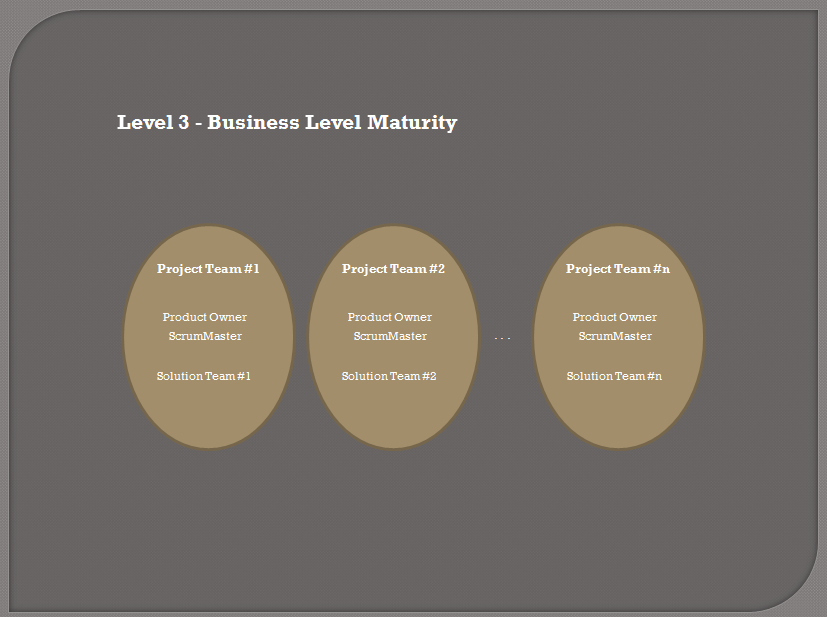
Level 3 – Business Level Maturity

At this level, the solution teams have integrated the business people in the model. Collaboration (and trust) has increased and a partnership relationship is increasing.

Agile Maturity Model

Team

  • Scrum Masters are in place
  • The 3 Scrum roles are well understood and respected
  • If there is more than 1 Scrum team, a Scrum of Scrum has been put in place
  • External help has been used to achieve this level of maturity
  • Team members are attending Agile conferences

Department

  • There is confusion around the roles of: business analyst, architect, database administrators and project managers
  • The process is documented and tends to be consistent across projects
  • External help has been used to properly implement the Agile practices

Business

  • A Product Owner is clearly identified and may be dedicated to their project
  • The concept of incremental and iterative development is gaining more acceptance from the business representatives
  • Process is slowly expanding within the business side
  • Product Owners bring some of their colleagues to end-of-sprint demonstrations

Project Managers

  • Starting to be aware of the new practices used by some of the teams
  • Mostly resistant to change since they are lacking information about the new process
  • Follow the traditional project management approach
  • Do not consider the Agile approach to be very solid for large scale projects

Managers

  • Awareness is increasing at the director level within IT and Business of the new Agile approach
  • Many assumptions and misunderstanding remain
  • A strong evangelist is in place to promote the new approach and bring together the IT and business side of the organization

Results

  • Project teams using the Agile approach are more productive
  • Moral of the people using Agile is much higher than those outside the Agile teams
  • Some friction with project managers and people managers remain where most people tend to fall back to their traditional paradigms

Level 4 – Project Management Level Maturity

At this level, the project management approach is modified to include some of the Scrum practices. Although the department still mostly relies on the traditional PMBOK recommendations, Scrum has been integrated in the project management approach.

Agile Maturity Model

Team

  • There is a clear segmentation between the role of the Scrum Master and that of the project manager
  • If there is more than 1 Scrum team, a Scrum of Scrum has been put in place
  • Interference with the team’s activities is almost eliminated
  • The team is autonomous and the Scrum rituals and artifacts are respected and standardized

Department

  • The department has adopted many of the Scrum practices and artifacts and are using them consistently
  • Much of the confusion around the roles of: business analyst, architect, database administrators and project managers have been eliminated
  • The process is documented and is consistent across projects
  • External help has been used to properly implement the Agile practices

Business

  • Product Owners are clearly identified and are dedicated to their project
  • The project manager is well accepted and is part of the Product Owner team
  • The concept of incremental and iterative development is fully accepted from the business representatives
  • Process is expanding to the business side

Project Managers

  • Projects managers are fully aware of the new practices used by the teams
  • Resistance to change has been replaced with adaptation of the traditional approach to include a more Agile approach
  • Agile is accepted as a solid approach for large scale projects

Managers

  • Awareness of the new Agile approach is increasing at director level and above within the IT, Business, and Project Management organizations
  • Some assumptions and misunderstanding remain for managers
  • Training initiatives have begun for management and attendance is high
  • A strong evangelist is in place at the management / executive level to promote the new approach

Results

  • Project teams using the Agile approach are more productive
  • Moral of the people using Agile is much higher than those outside the Agile teams
  • Friction between traditional roles are being handled

Level 5 – Management Level Maturity

At this level, managers have adapted their management style to support an Agile organization. Organizational structures and reporting mechanisms are better adapted for collaboration and improved for increased performance.

Agile Maturity Model

Team

  • Scrum Masters are in place
  • The 3 Scrum roles are well understood and respected
  • If there is more than 1 Scrum team, a Scrum of Scrum has been put in place
  • External help has been used to achieve this level of maturity
  • Team members are attending Agile conferences

Department

  • The department has adopted many of the Scrum practices and artifacts and are using them consistently
  • There is no confusion around the various roles surrounding the projects
  • The process is documented and is consistent across projects

Business

  • Product Owners are clearly identified and are dedicated to their project
  • The project manager is well accepted and is part of the Product Owner team
  • The concept of incremental and iterative development is fully accepted from the business representatives
  • Process is expanding to the management level of the organization

Project Managers

  • Projects managers are fully aware of the new practices used by the teams
  • The traditional project management approach has been adapted to include a more Agile approach
  • Agile is accepted as a solid approach for large scale projects
  • Review the best practices to adapt to changing realities

Managers

  • Have fully transferred the authority and responsibility to the teams to allow them to do their job properly
  • Avoid interference and micromanagement
  • Promote collaboration and teamwork
  • Support continuous learning and do not systematically penalize failures
  • Adapt their management style to the context of their team

Results

  • The various projects using Scrum are more productive than those using a traditional approach
  • Moral is high all around
  • Friction around the new approach has disappeared
  • Strong collaboration between all parties involved
  • Organization is able to quickly react to changes in its environment
  • Management is considering implementing Agile to projects that do not require software development

Level 6 – Corporate-wide Level Maturity

Utopia or the nirvana? At this level, the entire organization – the people, the processes and the tools are aligned with the Agile principles and values. As I haven’t had the opportunity to witness such an organization (yet), I am unable to describe the criteria to be used to qualify for this level.

Other useful Links

  • Share/Bookmark

Want to join Pyxis? Here is a message to the new employees

January 28th, 2010 Martin Proulx 1 comment

Welcome

If you did not already notice, Pyxis is a different company. You have surely seen that the number of smiles per hour is much higher than in traditional organizations. There are several reasons contributing to this phenomenon but for now we just want to explain the governance model used so that you understand exactly what is expected of you.

What is governance?

Corporate governance is the set of processes, customs, policies, laws, and institutions affecting the way a corporation or company is directed, administered or controlled. Corporate governance also includes the relationships among the many stakeholders involved and the goals for which the corporation is governed. - Corporate governance – Wikipedia, the free encyclopedia.

What is the management philosophy?

The management philosophy of François relies heavily on the work of Peter Block and more specifically on the audio book “The Right Use of Power: How Stewardship Replaces Leadership“. If you do not know this audiobook, we invite you to invest 3 hours to understand the philosophy. The alternative is that you will have to reconstruct the enigma over the coming weeks, so this is certainly a good investment.

What does it mean to work at Pyxis?

Before going further, it is important that you know the values and mission of Pyxis and our perspective of capitalism in the 21st century. Then comes the most difficult challenge for a new employee, you must rid yourself of your mental model of a traditional business because most of your references will not apply at Pyxis. Want examples?

In a traditional business At Pyxis
The boss tells me what to do. I determine how I can help Pyxis reach its objectives.
I wait for directions. I initiate the right activities.
I have a boss. There is no hierarchy.
I must ask for permission. I make decisions, communicate them and make them visible on our wiki.
The company takes care of me. I take care of myself.
I hope the organization will help me develop my skills. I develop my skills while working on initiatives that will help Pyxis achieve its objectives.
I do not take any risk. I learn from my mistakes.
I wait for my boss to solve my issues. I solve the problems.
I look for the leaders. I am a leader.
I wait for someone to assess my performance. I initiate the 360-degrees feedback evaluation.
I can’t wait for retirement. Week-ends are too long and I can’t wait to go back to work on Monday

OK, let’s not exagerate!

What are the teams at Pyxis?

Pyxis works in “communities“.

What do I do now?

If you have more questions than answers after reading this page, it’s normal. Most people need time to assimilate new concepts and our mode of operation. If you have questions, ask them to the people around you or help others by adding them to our wiki.

  • Share/Bookmark

Interesting blog posts (January 22, 2010)

January 22nd, 2010 Martin Proulx No comments

On the importance of creating the right organizational culture (Thanks to Andrew)

By the time we got to 100 people, even though we hired people with the right skill sets and experiences, I just dreaded getting out of bed in the morning and was hitting that snooze button over and over again Corner Office – Tony Hsieh of Zappos – Celebrate Individuality – Question – NYTimes.com.

On why an Agile approach is better suited to deliver value (Thanks to Alfonso)

Most organizations that depend on software are struggling to transform their lifecycle model from a “development” focus to a “delivery” focus. This subtle distinction in wording represents a dramatic change in the principles that are driving the management philosophy and the governance models – Improving Software Economics

On the meaning of Agile transformation for managers

What many people mistakenly do is equate agile project management with doing more work, with less documentation and fewer people. Although the premise is to get more done in a more favorable way, I have never met a team that could successfully implement agile principles without having to slow down first - VersionOne – Agile Adoption For Managers.

On the fact that the true value of an organization is not mapped via its organizational chart

But it’s not the fact that you have many more boxes and lines that I’m most envious of.  It’s your “white space” I want – Oh, Yeah? Well, My Org Chart is Bigger and More Beautiful Than Yours!

On the need to manage self-organized teams when required

The interesting thing is, the further we go into agile management territory the less typical the managerial job we expect. Teams are self-organizing and cross-functional, and sometimes we think a manager should just get out of the way. By the way, surprisingly often this is exactly the best choice. But whenever one of the asshole-moments is needed, it is time to show up and do what has to be done. Otherwise the atmosphere starts rotting as people wait for someone who will fix things. Someone who will do something about this guy adding a new technology every time he reads some nice article. Someone who will deal with that lass taking a few days off because she doesn’t really care about the project being late and the team working their butts off to get back on the right track. That’s always a job for a manager, and a harsh one, no matter how self-organized the team is - Good Managers Sometimes Have to Play Assholes – NOOP.NL.

  • Share/Bookmark

Does your organization support prostitution?

January 3rd, 2010 Martin Proulx 4 comments

Does your organization’s compensation model and your personal attitude support prostitution?
[Note: The definition of prostitution is provided at the end of the blog post. In the context of this post, I am referring to the second and less often used definition.]

The Scenario

Do you deliver value or paperwork?

As the head of a large Information Technology department, you walk by Michael’s desk one afternoon and to your surprise, you notice that your system administrator is frantically switching from Google to Chat to a discussion Forum. You recall similar observations a few weeks ago so you quickly wonder if, at $80K per year, you are getting your money’s worth for a system administrotor who always seems to browse the internet. To make matters worst, you don’t even remember when was the last time your company ran into serious systems issues. Do you need Michael on your team? Maybe he is a good candidate for the headcount reduction you have been imposed by Finance.

A few days later, on your way out of the office around 7:15 pm you hear key strokes and notice that Kim is still working. You remember approving Kim’s over time report last month and start to realize that the increase in ERP support calls might be starting to impact Kim’s work-life balance. Remembering your conclusion about Michael, you wonder if you shouldn’t close the system administrator position and add resources to Kim’s team. At $55K per year, you would still be able to cut your budget spending. Pleased with your conclusion, you briskly walk to your car hoping for a nice family dinner.

A New Concept

Here’s a new concept. For people working in most traditional organizations, this will sound like a really weird concept but what if employees decided their own working hours? I’m not talking about the flex time concept where people decide what time they wish to start and end their work day but actually decided how many hours and which hours they worked?

Typically, the traditional work week varies by company and by country. A standard work week in Canada is somewhere between 35 and 40 hours per week. Some would argue they work many more hours per week but that’s not where I want to take this discussion.

Imagine for a moment you stopped controlling the hours worked and focused instead on the results. Granted, this is a much more complex endeavor but in my opinion much more suited to year 2010.

The Old Paradigm

At the beginning of the industrial age, many employees were paid “by the piece”. For every bolt fastened, shirt sowed, or widget delivered they received a small amount of money. Eventually, companies realized that it would be more predictable and easier to manage if people were paid by the hour. Needless to say, the model has somewhat evolved and employees are currently paid by the hour, by the day, by the week, or by the year but the model pretty much remains the same.

The New Paradigm

The new model I’m proposing is to offer a fixed salary (or a risk salary), without any expectations of number of hours worked. Instead of expecting people to work 40 hours per week, people would be expected to deliver value or results. As I mentioned, it is certainly more difficult to set up the type of results expected but on the other hand, isn’t this the basis of commerce – I pay you $x for this good or service without any consideration about how many hours were required to produce it. The production piece is the responsability of the seller, not the buyer.

Back To The Scenario

Pleased with the previous day’s conclusion, you call into your office Michael and Kim’s direct supervisor to share your thoughts. Michael’s boss explains that since hiring him 2 years ago, systems outage have dropped 92% as Michael is consistently looking for ways to improve systems availability. He heavily praised Michael for creative and pragmatic solutions and despite the fact the Michael rarely has to do overtime, he would recommend him for a promotion.

Slightly shocked, you turn to Kim’s boss and ask for comments on her employee. With a grin on her face, Kim’s manager tries to hold back her answer as it certainly wouldn’t make you look good. She explains that Kim clearly lacks analytical abilities which is why she has to spend more time than all her colleagues solving similar issues. In addition, Kim is a poor team player. She likes to think of herself as a super-hero and she prefers trying to handle problems without the help of her team mates which often leads to repeated issues as the root problems are rarely solved properly the first time around. Despite many attempts at helping Kim with her shortcomings, she doesn’t feel the need to improve since she is often praised by the head of the department for putting in long hours…

(Silence in the room)

Embarrassed and apologetic toward both managers, you realize your attitude toward the number of work hours per week may have had the opposite effect that you were originally looking for. You genuinely thank your employees for their valuable feedback and wonder if you shouldn’t aim to leave early today…


pros·ti·tu·tion (prst-tshn, -ty-) - NOUN:

  1. The act or practice of engaging in sex acts for hire.
  2. The act or an instance of offering or devoting one’s talent to an unworthy use or cause.

  • Share/Bookmark

Hierarchies aren't evil… but people can be!

November 16th, 2009 Martin Proulx 11 comments
Hierarchies aren't evil... People are!

Hierarchies aren't evil... People are!

Do you ever say to yourself “I wish there was no hierarchy in our company“?

Wouldn’t it be a perfect world if there were no hierarchy in organizations? Everyone working in harmony, collaborating to achieve their goals with no annoying boss telling anyone what to do. In this hierarchy-free world there would be no supreme ruler over the teams, only happy people delivering their work with birds chirping in the background…

OK, I realize I’m pushing it a little but people who systematically oppose to specific organizational structures often have an idealistic perspective of the world. Fortunately, the world isn’t black or white, there are many nuances.

I have had discussions about hierarchy-free organizations with many people over the last few months. Repeatedly, people bring up the same reasons why they don’t like hierarchies. From their perspective, hierarchies are bad because:

  • they don’t let employees perform their work as they wish;
  • they allow authority over people;
  • they break communication channels;
  • they create a distinction between the boss and the employees;
  • they don’t treat people equitably;
  • they offer more benefits to people at the top;
  • etc.

What if hierarchies weren’t the problem? What if the cause of these issues was somewhere else? What if the organizational structure wasn’t the real problem? Not that I am a huge fan of hierarchies, but I do not believe the organizational structure is the real problem – people are!

Let me explain my perspective.

I feel that blaming hierarchies as the reason people hate their job and feel under-appreciated is short-sighted. Organizational structures have much less to do with how people feel than the management style and attitude of the leaders.

Let me repeat that statement. I believe that the attitude and behavior of the leader has greater impact on the team members’ performance and happiness in the workplace than the organizational structure under which they operate.

You are not convinced? You might want to try this exercise.

Can you think back of a time when you felt empowered to do your job and were happy to be at work? Can you recall a time when you would invest long hours working on a project and your energy level was going though the roof? If you answered yes to these questions, ask yourself this other question “was it because of the hierarchy-free structure or the leader’s attitude”?

If you have had the opportunity to work for a great leader – someone who gives you freedom to do your work, holds you accountable for the results, is always supportive and available for mentoring, and gives you credit for your work – you will immediately realize that the leader’s behavior and attitude were the underlying causes of your satisfaction. A bad leader in a hierarchy-free organization will make everyone’s life miserable while a good manager – even in a position of authority – will get amazing commitment from his people.

It might be that the people against hierarchies are ones that never had the opportunity to work for a great leader and so, assume that the organizational structure is the issue. I wish them to find a great leader to work with because in the end, the leader’s attitude has much more to do with a happy and productive work environment than the actual structure of the organization.

  • Share/Bookmark

FAQ: Communities in the context of business

November 11th, 2009 Martin Proulx 1 comment

Since my first post on this topic, a few people asked me why I thought communities were a new way to organize and what complexity there was in applying communities to a business setting (i.e. for-profit organizations). I have defined what is a community in a business context and some of the rules they follow. Below are some of the recurring questions and their associated answer.

In a business context, what is a community?

In a business context, communities are similar to functional departments with some fundamental distinctions. In traditional setting, members of a functional department or of a project team work together to achieve a goal. With some exceptions, team members share nothing but their common goal and a common boss. By comparison, in addition to sharing a common goal members within a community also share common values and culture and they operate within agreed upon self-defined norms. I provided a few examples here.

Why are communities in the context of business different from other communities?

Communities that come together to carry out a goal are common but communities that aim to generate revenue to autonomously support themselves are no frequent. In traditional for-profit organizations, shareholders through board members select the management team for the organization. The management team (President, CEO, COO, etc.) become accountable to the board for their performance and as such almost always use a top-down (command-and-control) approach.

By contrast, communities rely on a bottom-up approach to decide their goals and those are seldom oriented toward profit.

Aren’t communities completely disorganized and as such, couldn’t work in a business context?

Communities could be disorganized but they wouldn’t be effective. Communities typically set up rules that will allow them to work efficiently. What may seem like disorganized entities within traditional organizations may actually bring better results.

In certain situation, a larger community may ask sub-communities to run within certain guideline and as such, would cut disorganization.

Why use communities as organizational structure?

Because communities are living cells, they are components of a living organism and are able to adapt to their environment.

A community can be born, live and die. A community arises when 2 people come together around a common goal, and decide to form a community.

A community dies when less than 2 people deploy energy to sustain it.

What rules govern a community?

I already provided an answer in this post but typically, communities work by the rules defined by their members. Some rules are implicit while others are explicit and clearly adapted to the needs of the community. The community may decide to create a space for expression and revision of its rules.

In his blog (English translation by google) Tremeur talked about the notion of rules and how they are relevant to the functioning of communities.

How can someone join a community?

Individuals can join a community by expressing their interest in the community, ensuring they are motivated by the goals the community has set, and by adhering to the rules of that community. Further information on this topic can be found in this post.

Can a community expel a member?

According to the rules under which it operates, the community may choose to expel one of its members. It is important to establish that the decision to evacuate a member is serious and can not be done without the approval of the majority (or unanimity) of group members.

An individual is part of a community if he is active in this community. Being active in the community means to actively and positively contribute to achieving the goals set by the community by working with other members of this community. If an individual is not active in a community, it is not part of that community (even if his name appears in the list of members).

How many communities can an individual belong to?

People can belong to as many communities as they wish. Individuals alone are responsible for setting their limit.

What is the largest number of members in a community?

There is no set limit.

If the number of members is jeopardizing the operational effectiveness of the community (9 members in a team would be a reasonable number), then it is likely that the community will divide itself into 2 communities, each pursuing different sub-objectives.

What is the role of leader of the community?

A leader is appointed only if the community decides to appoint one, and its role is defined by the community. Typically,

  • the leader ensures the respect of the common rules that the community has given itself;
  • the leader ensures that the community is visible and transparent;
  • the leader is the one who will link with other communities.

Who chooses the leader of a community?

Unlike traditional businesses where leaders (managers) are selected or appointed by their supervisor, the leader of a community is chosen democratically by the members of the community. Similar to the concept of holacracy, the leader emerges from the group because of its expertise and its commitment to advancing the community towards achieving the goals it has set.

Are all communities are connected?

Maybe, maybe not.

The link between 2 communities may be at least 2 kinds:

  • members belonging to more than 1 community;
  • a need expressed by a community for the services provided by another.

A community that needs support or resources from another community therefore becomes automatically linked to another community.

Can a community exist independently?

If it apart from other communities, the answer is “yes”: For example, communities of practice are primarily in service to their members, and this is enough.

Is that all communities have financial goals?

No. Basically, communities set their own goals.

As a commercial enterprise, some communities have financial goals to make sure growth and sustainability of the organization.

By contrast, other communities will be directly or indirectly serving communities with financial goals but will not themselves financial targets.

Other communities are communities of interest and have no link with strict financial targets.

  • Share/Bookmark

How can someone Join a Community? Can people leave a Community?

October 14th, 2009 Martin Proulx No comments

Joining a Community is Simple

Everyone can ask to join a community if it is open to integrate new members. Once again, the community decides how many members it will allow and which skill set, profile and experience is required to qualify. Assuming the community is accepting new members, anybody who believes they meet the requirements may ask to join the community.

Leaving a Community is Simple

Based on the norms established by the community, people may leave with (or without) advanced notice. Communities are usually fluid and allow for members to join and leave in order to support the emergence of new ideas and new energy to reach the set objectives.

In order not to disrupt significantly the activities of the community, members are usually required to provide advanced notice to the other community members.

The Community May Ask People to Leave

Norms vary for each communities but in our situation there is a fundamental rule that states the “no single individual can have authority over another individual”. As such, community members cannot be expelled or fired based on the decision of a single individual, including the community leader. Community members who fail to comply to the norms and values of their group may be asked to leave if the majority of community members support the decision.

As in the case of a voluntary departure, the community is required to provide advanced notice to the member they wish to expel.

For more content on the topic of communities, you may follow the community tag.

  • Share/Bookmark

Inline with an Agile Organizational Structure

August 6th, 2009 Martin Proulx 2 comments

As time goes by, I realize there is no such things in life as coincidence. I’ll probably expend on this topic in an upcoming post but for now I’ll jump to the purpose of today’s blog post.

If you have been reading some of my recent posts (this one, this one and this one) you will notice that I took upon myself to help implement an innovative organizational structure for the organization. As a consequence, Raphaël suggested I take a look at Holacracy.org.

I had the pleasure of sitting in on the webinar given by Brian J. Robertson from Holacracy and found the content was very much in line with the organizational structure we are aiming to implement. In short, here are two take-away I got from the presentation:

  • We need to distinguish the organization from the individuals that compose the organization.
  • The organization has to be purpose driven. Its goal is not only to generate profits for the shareholders but to have a purpose of its own.

Although there is much more to this than these 2 points, the 60 minutes presentation gives a good introduction to the concept. I am unfortunately unable to attend their next events in Philadelphia and Dallas both hopefully they will add events to their calendar shortly.

If you get a chance, I suggest you sign up for one of their upcoming presentation and share your thoughts.

  • Share/Bookmark

Can you grow a business profitably while improving the lives of people?

August 5th, 2009 Martin Proulx No comments

In today’s post, I am publishing a translated version of the blog post I co-wrote with François Beauregard, President and Founder of Pyxis Technologies. The article is reproduced here with permission.


Quite by chance I came across an article (The Smart Growth Manifesto) that triggered some interesting thoughts in my mind. I immediately sent the article to François asking him about Pyxis’ position compared to what is described in the article as the 21st century capitalism.

Below is the content of our exchange and personal perspectives on this article.

Martin: In recent years, I frequently asked myself “Are we the last generation for whom the standard of living is better than the generation that preceded it? Will our children and our children’s children have an income level lower than ours? Will they be happier? “. The type of organizations described in this article is rare but I believe that Pyxis would qualify as one of these companies. What do you think?

François: In your opinion, how does Pyxis rank compared to other companies?

Martin: I think we are definitely in the “trail blazers” category. Very few organizations have a business model that fits the way of thinking and operating described in the article. I believe we could establish an exciting objective to continue our rapid growth while remaining true to our business model. In fact, the model described in the article is close to the concept of  ”NPII” (Number of Positively Impacted Individuals) and the concept of welfare which we often referred to at Pyxis – maybe without the negative connotation of the long robes, the sandals and the flowers in our hair! I like the phrase People Outcome used in the article and the definition of smart growth – “smart growth is sustainable, equitable, and resilient“.

Does this speak to you?

François: Of course it speaks to me, it’s screaming in my head! Whether or not we agree with everything stated in this article, it certainly raises several interesting lines of thought and it seems very healthy to ponder about them and identify elements that could lead us to make improvements to our organization. Let’s start with the first pillar Outcomes, not income that translates for me as well-being more than remuneration. I have been repeating for a while now that the fundamental objective of Pyxis is not to generate profit for its shareholders but to achieve its mission, its purpose; to the point that many believe that money has no importance at Pyxis. Money is absolutely essential for a company to function, it is the air and without air the system can not breathe and it dies. In this analogy, participants in the enterprise would be seen as the muscles that allow the company to act, to make things happen.

Having a purpose that is shared by all ensures that the system is geared towards achieving a fundamental objective and avoids wasting energy to move in inconsistent directions. For Pyxis, the reason for being is: Pyxis helps software development organizations to become places where results, quality of life and pleasure coexist in a sustainable way by being first an example of what it proposes to its customers. Having defined a clear future makes it possible to set concrete targets.

To go back to well-being more than remuneration, it is my firm belief that if the employees are also the shareholders of the organisation that points to (but not absolutely) a more responsible (sustainable) and equitable model of redistribution of wealth. This also leads to a better balance between the desire to produce economic benefits in the short term for shareholders, and long-term value creation and welfare for the employees (in fact the shareholders). In our case, we set up a worker-shareholders cooperative (WSC) who now holds 30% of the companies’ share (Class A) and there are efforts underway to significantly increase the percentage of shares held by the WSC of Pyxis.

I’d like to hear you on Connections, not transactions.

Martin: It’s interesting that you translated Outcomes, not income as well-being more than remuneration. At the last Open Space held at Pyxis in April, I frequently used Wellness, rather than ownership. I think it extends the notion of personal happiness to a wider meaning than the simple financial perspective.

On the other hand, I agree with you that some people within our organization incorrectly interpret the message when you state that the main objective of the organization is not to generate profit. I heard some people mention that happiness and pleasure were the fundamental objectives and that money is not a priority. I know you try to correct perceptions whenever you have the opportunity.

On a completely different perspective, the notion of fairness is a concept that is also confusing for some and causes major discrepancies. In my opinion, fairness is a concept that applies to both the opportunities and the results. First, fairness in opportunities means that the largest number – ideally all – have access to participate in the economic process and to benefit from it. I am not talking about charity or social programs, but a true opportunity to be part of the economic process. I like, among other things, the concept of micro-lending such as the Grameen Bank or organizations like Kiva, which allows individuals to participate in the local economy.

On the other hand, fairness in earnings means that individuals are rewarded in proportion to their contributions. Some mistakenly believe that equity in the results means that everyone must have an equal portion of the benefits. Fairness and equality are not the same thing. I think fairness means that the benefits are available to all of those who participated in the achievement of the objectives and the distribution is in proportion to the contribution of the individuals. Recent examples of senior American executives who pocketed large bonuses when their company came close to bankruptcy is quite absurd.

In line with the concept of welfare, Connections, not transactions take us back to a more human perspective of trade and economics. Pre-industrialization commercial transactions were much more collaborative. The local farmer didn’t aim to maximize its revenues at the expense of its customers. Not only did the farmer not have that goal, but the maximization of income was not in his interest since he was himself a client of his customers. If the farmer inflated the price of his eggs to increase his personal wealth, the baker would do the same. The system would balanced itself as short-term profit of the farmer would be quickly eliminated by higher prices for goods purchased from the baker.

What do you think?

François: When I read the previous paragraphs, I can not help but think of Lean and references to the principle of optimizing the whole process and avoid local optimizations. It’s been quite some time that Toyota has understood that the objective is to optimize the supply chain as a whole to create maximum value for all stakeholders. This is quite contrasting with what I saw in North America since the beginning of my career where I feel that the mental model applied to maximize the value received is to keep pressure on the suppliers without considering the value created for them. In other words, in this mental model, if a supplier is successful, it is absolutely necessary to renegotiate their prices downwards to ensure the organization obtains the maximum value for its money. This is the model of the “pressure on the throat” that inevitably leads to sub-optimizations and ultimately to conflicts.

Connections, not transactions in my opinion represents a huge challenge because it forces us to significantly revise the way we do business. When I talk about my perspective of business to customers and suppliers and I sometime have the impression that they take me for an extra-terrestrial.

Let’s now go to People, not product.

Martin: For People, not product, I will tackle this one from a different angle than the one used by Umair Haque. For me, the perspective is less about product and more about humanization of work. For too long, organizational structures assumed that people at the bottom of the pyramid were less competent and less capable to determine for themselves how best to perform their tasks. The methods, processes and outcomes were defined at the top of the hierarchy, while execution was delegated to non-managerial staff.

As the economy turns toward services and knowledge, the role of the managers is losing its importance while advanced technical expertise increases in value. The challenge is therefore to put in place mechanisms – not structures – that maximize cooperation and knowledge sharing to achieve the organizational objectives. Decentralized and non-hierarchical structures set up within Pyxis are a good example, aren’t they?

François: You knew that is a core belief of mine! Let’s begin with People, not product. I was strongly influenced by the work of Peter Block, in particular his book Stewardship. At Pyxis, I tried to create a strong culture focused on individuals and their individual responsibility (not to be confused with individualism). I’m looking for a way to explain it all and I see no other way than to express my vision of the enterprise systems. Here I go.

A company is a human system whose complexity is growing exponentially, a system comprising 100 individuals is much more than 10 times more complex than a system with 10 individuals. For the purpose of this post, let’s imagine for a moment a company called Chaotic Inc. which includes 100 employees. In this organization, there is no structure, no rules, no identified purpose. It is interesting to observe Chaotic Inc. but it is obvious that the system is not optimal for achieving a fundamental objective.

We have discussed above, giving the company a purpose that is understood and shared by all stakeholders to give direction to the system thus avoiding to some extent that stakeholders spend energies tackling fundamentally incompatible goals. Clearly establishing the values for the participants to understand the appropriate behaviors and encouraged those behavior when operating inside the company (the system). In other words, some defining rules for what is in play and what is out of play. So one can imagine that Chaotic Inc. after a collaborative exercise to establish its purpose, its values and vision over several years is significantly more effective then it would have been even if its operations were still relatively chaotic – sort of speak.

To become a successful business and achieve its purpose and its vision, Chaotic Inc. should probably put in place structures. It then becomes quite difficult to adapt from a systemic point of view, since putting structures in place sediments the system because if the structure is inadequate with an evolving system, removing the inappropriate structure in order to replace them for better suites structures requires a substantial quantity of energy. It is therefore essential to establish mechanisms that encourage flexibility and dynamism of the system (more details about this topic in an upcoming blog post). The basic structure most common in our organizations is the hierarchical structure and it is inappropriate to me in a system as complex as a modern business. So then what is the alternative? At Pyxis we adopted a principle of mapping the areas of responsibility without violating the fundamental principle that no individual can be responsible for someone else. This helps to loosen the system by clarifying who is responsible for what, and specifying processes (more specific rules about what is in play and what is out of play) without giving formal authority.

Within Pyxis, we also put structures in place to develop the maturity and competence of all employees. It may be interesting to write a few posts to elaborate on these structures. Much work remains to be done but I think we have in place the foundations of a highly-performing human system. As such, Pyxis’ 2013 vision is: By implementing what we believe, repeatedly obtain extraordinary results in the projects we are involved with.

Whew! You want to initiative Creativity, not productivity.

Martin: There are considerable efforts being invested in achieving maximum productivity, i.e. producing as much as possible at the lowest cost. In my opinion, the perspective of productivity without other consideration is absolutely incorrect. Creativity, not productivity is for me a fair and sustainable productivity, which is different than simple creativity aimed only at improving productivity. In several sectors, the unit production costs are so low that organization come to a complete waste of resources at the end of the cycle – they sell 60% of their production at full price and they discard the remaining 40% since its production cost is not high.

In the context of software development, this is equivalent to writing more lines of code at a lower unit cost. Organizations find ways to ensure that resources produce more (extensions of work hours, outsourcing, time constraints) without wondering if there are better way to achieve results. Using creativity and innovation in production methods, achieves better results and hence gives more value to the organization. I believe that evolutionary processes are not desirable. It takes innovation and revolutions rather than evolution methods.

It is time that organizations begin to think in terms of results rather than accounting costs or productivity as per the Taylorist approach – this is what Pyxis is aiming to do.

At the end of his article, the author raises an interesting question Can you build a business powered by smart growth? I know you would answer yes to this question. The question that applies to Pyxis is rather, how does it happen?

François: It is a difficult question. What comes to mind is how Peter Block discusses this issue in his work where he talks about the role of the social architect, creating space for individuals to act on what is important for them. I take this personal commitment to Pyxis and strongly wishes that others would do the same.

Martin: Finally, our exchange on the theme of 21st century capitalism has raised the following question for me: “For the shareholder-employees, what concrete evidence would show that the business model set forth by Pyxis really works?” Although preliminary, my response would be as follows:

Using varied and innovative approaches Pyxis substantially increases the level of performance of the companies it serves. As such, Pyxis generates a high profitability that it re-distributes to its shareholder-employees and to the community.

To its shareholder-employees:

  • By introducing the 80% rule where shareholder-employees receive 100% of their salary while working 80% of the time on an annual basis. Individuals use the remaining 20% to spend more time with their family and their friends, their colleagues and their community;
  • By paying annual bonus and dividends in relation to company performance;
  • By increasing the capital value of the company.

To the community:

  • By allocating financial and human resources to advance social causes.

I’ll leave you the last word.

François: I really enjoyed this collaborative mode of writing and I encourage everyone to try it out. Martin, thank you for having kept our energy level high and helped me write about a topic that is really close to my heart. Fortunately, we both discovered there are plenty of opportunities continue this conversation.

Stay tuned …

  • Share/Bookmark

Helping employees grow without an HR department?

July 21st, 2009 Martin Proulx No comments

Our organization is using an innovative human resource management approach inspired by the “golfercaddy” relationship in golf. Although the approach isn’t fully matured and there are still adjustments to be made, I believe there is value in sharing the process.

Some background

During its early years, human resources management was done entirely by the management team. The communication was centralized and the company’s founders had relations with all employees. They were responsible for hiring, annual evaluations and taking decisions relating to salary revisions. The fast growth of the organization highlighted certain limitations:

  • Managing the relationships between employees and the founders was increasingly difficult to maintain as the organization grew;
  • The centralized communication channels weren’t efficient;
  • The willingness to develop a new process without hiring specialized HR specialists;
  • The management of special situations and salary determination lacked transparency and were perceived to be unfair.

To address these emerging issues, the organization developed the “Caddy” process, a model of decentralized community-based human resource management.

What is a Caddy?

In golf, the caddy is the person who carries the golf bag, gives advice and provides moral support. A good caddy is aware of the difficulties, obstacles and peculiarities of the course, as well as the best strategies to play the course. The caddy is not the one who plays the game, the golfer is!

Objectives of the process

The objective of the process is to support employees’ success and monitor their well-being. In addition, the caddy process is a way for all employees to participate in the management of the organization by helping their peers to receive the proper feedback and skills to be successful in their role. The caddy process is deemed more efficient than the traditional hierarchical model.

The process

When an employee joins the company, he/she is assigned a caddy for a period of six months. After that period, an employee may decide to change caddy any time. A discussion between the golfer and the new caddy is required to identify the expectations of each party and determine if the match is possible and desirable.

Role and responsibilities of the Caddy

The caddy has certain responsibilities to the employee. In a traditional organization, these responsibilities are held by the Human Resources Department:

  • Communication of the corporate strategy;
  • Keeping track of business objectives;
  • Accompanying the employee in his career development and providing the support to develop new skills;
  • Assisting the employee to set goals and support them in achieving these objectives by offering the means to do so;
  • Preparing the salary revisions and making recommendations.

Caddy Team Charter

“I am unwavering in the success of each of my players, my caddy and the caddy team”.

Why?

Because people are the most important asset of the organization. Their development is linked to the success of the organization.

What?

The Caddy process is based on trust and respect. It is a relationship of support and coaching without direct authority.

Who?

The Caddy is a humble person with great listening capabilities. He has the courage to confront the person if necessary and the wisdom to do so in respect of the person. Above all, he shares a common goal with his golfers: the professional success and development of the latter.

Mean

The Caddying is one of the most important roles in the organization and he is recognized as such, encouraged and valued by the organization.

Result

The Caddy process has a significant positive impact on the development of the golfer.

  • Share/Bookmark