I am very aware of the previous debates on the need for an Agile Maturity Model (see the Other Useful Links at the end of this post). I actually agree with Esther Derby’s recent post …
How agile you are doesn’t matter. Whether you are 50 per cent agile, 90 per cent agile or agile through and through (what ever that means), doesn’t matter. What does matter is that your company is satisfying its customers, stakeholders, and employees. (Achieving Agility: Means to an End, or End in Itself)
But let’s face it, people like to know where they stand compared to others. Starting at a very young age, we have been raised and trained to compare our results to others in an attempt to reach the next level – whatever the next level may be.
We get into such comparison as:
- Are my grades better than Tommy’s?
- Can I run faster than Carl?
- Am I stronger than black belt Anna?
- Did I earn more frequent flyer miles than Frank?
It’s the same thing with Agile. People – managers and executives mostly – really have the need to know they are headed for the top of the maturity model. It may not make much sense but they have been raised and trained to measure, to compare, and to brag when comparing favorably or to adapt when comparison isn’t positive for them.
As I already stated, I agree with Esther when she says that it doesn’t really matter how Agile you are. What matters are the results. So along those lines, I believe it is important to associate the level of maturity and the related results which I believe exist and can be demonstrated.
Unfortunately, there isn’t much hard data to demonstrate that achieving a certain level of maturity provides x% of improved performance or y% cost reductions but most of us who have been implementing Agile within organizations would agree that that higher the maturity, the better the results. So it is based on these observations that I decided to present yet another Agile Maturity Model.
As recently reported by Forrester, Scrum being the most adopted Agile approach these days, the proposed maturity model heavily relies on the adoption of Scrum practices with a lesser consideration to other practices such as: Agile Modeling, Feature-driven development – FDD, Test-driven development – TDD, eXtreme Programming – XP, etc. By no mean I am rejecting or considering those other approaches non-important. I built this model mostly on Scrum because this is the comparison organizations are asking us to be evaluated on at this time.
The Agile Maturity Model
Level 1 – Team Level Maturity
At this level, team members have decided to adopt Scrum and/or software engineering practices without asking for approval from their manager. Some of the well known practices are used but without consistency.
Team
- A Scrum Master is in place
- The Team has adopted some of the Scrum practices and artifacts but may not use them consistently
- The process isn’t documented and tends to vary by project
- Agile practices have been self-taught
- Process is limited to the solution team
- The team doesn’t understanding the language used by the business representatives
Department
- Outside the team, almost nobody has heard or understand what Agile means
- Other teams are unaware or not interested in the approach used by the Agile team
- Mostly business as usual
Business
- Unaware or not interested in the approach used by the team
- Business as usual
- Complains that what the information technologies team delivers is not what is needed or asked for
- Misunderstanding of the language used for the development team
Project Managers
- Unaware or not interested in the approach used by the team
- Follow the traditional project management approach
Managers
- Unaware or not interested in the approach used by the team
- Business as usual
Results
- Team is slightly more productive
- Moral is slightly improved
- Much friction with project managers, people managers and the business as the team members try to teach people outside the team what Agile is and what it can do for them
Level 2 – Department Level Maturity
At this level, the practices adopted by the team members have started to be imitated by other teams within the software development department. Some of the managers have noticed the positive results of adopting the Agile approach and are tempted to replicate what they observed.
Team
- A Scrum Master is in place
- Some of the teams have adopted some of the Scrum practices and artifacts and are starting to use them consistently
- Consistency across the teams is uneven and mostly depends on the leadership and perseverance of a few individuals
- Some of the process is documented but it tends to vary by team
- Agile practices have been self-taught or a coach was hired to help the team launch their initiative
- Process is limited to the department
Department
- Mostly business as usual
- Agile is sometime discussed in departmental meetings with some interest from people outside the team immediately impacted
- An increasing number of teams are adopting Agile practices
Business
- A business analyst acts as the proxy for the business representative
- Unaware or not interested in the approach used by the team
- Collaboration between the development team and the business side remains mostly unchanged except maybe for increased interaction between the 2 groups
- Business decision are still mostly made by business analysts or architects
Project Managers
- Starting to be aware of the new practices used by some of the teams
- Mostly resistant to change since they are lacking information about the new process
- Follow the traditional project management approach
- Do not consider the Agile approach to be very solid for large scale projects
Managers
- Unaware or not interested in the approach used by the team
- Business as usual
Results
- Teams that have adopted the Agile approach are slightly more productive
- Moral is improving
- Productivity varies from one team to the next
- Some teams’ productivity is decreasing since they have hit important hurdles
- Some teams have abandoned the new approach and have gone back to their traditional approach
- Some friction between the development and the business teams in light of the new approach
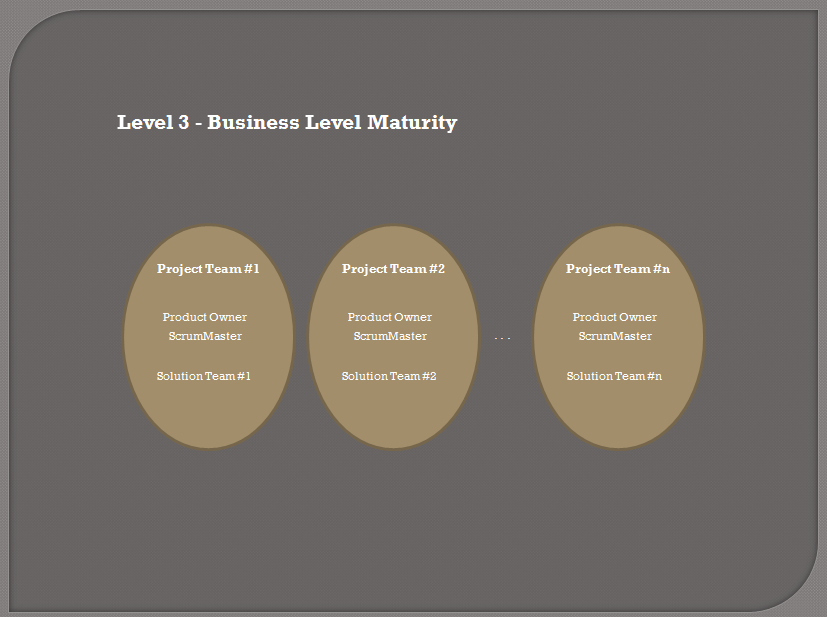
Level 3 – Business Level Maturity
At this level, the solution teams have integrated the business people in the model. Collaboration (and trust) has increased and a partnership relationship is increasing.
Team
- Scrum Masters are in place
- The 3 Scrum roles are well understood and respected
- If there is more than 1 Scrum team, a Scrum of Scrum has been put in place
- External help has been used to achieve this level of maturity
- Team members are attending Agile conferences
Department
- There is confusion around the roles of: business analyst, architect, database administrators and project managers
- The process is documented and tends to be consistent across projects
- External help has been used to properly implement the Agile practices
Business
- A Product Owner is clearly identified and may be dedicated to their project
- The concept of incremental and iterative development is gaining more acceptance from the business representatives
- Process is slowly expanding within the business side
- Product Owners bring some of their colleagues to end-of-sprint demonstrations
Project Managers
- Starting to be aware of the new practices used by some of the teams
- Mostly resistant to change since they are lacking information about the new process
- Follow the traditional project management approach
- Do not consider the Agile approach to be very solid for large scale projects
Managers
- Awareness is increasing at the director level within IT and Business of the new Agile approach
- Many assumptions and misunderstanding remain
- A strong evangelist is in place to promote the new approach and bring together the IT and business side of the organization
Results
- Project teams using the Agile approach are more productive
- Moral of the people using Agile is much higher than those outside the Agile teams
- Some friction with project managers and people managers remain where most people tend to fall back to their traditional paradigms
Level 4 – Project Management Level Maturity
At this level, the project management approach is modified to include some of the Scrum practices. Although the department still mostly relies on the traditional PMBOK recommendations, Scrum has been integrated in the project management approach.
Team
- There is a clear segmentation between the role of the Scrum Master and that of the project manager
- If there is more than 1 Scrum team, a Scrum of Scrum has been put in place
- Interference with the team’s activities is almost eliminated
- The team is autonomous and the Scrum rituals and artifacts are respected and standardized
Department
- The department has adopted many of the Scrum practices and artifacts and are using them consistently
- Much of the confusion around the roles of: business analyst, architect, database administrators and project managers have been eliminated
- The process is documented and is consistent across projects
- External help has been used to properly implement the Agile practices
Business
- Product Owners are clearly identified and are dedicated to their project
- The project manager is well accepted and is part of the Product Owner team
- The concept of incremental and iterative development is fully accepted from the business representatives
- Process is expanding to the business side
Project Managers
- Projects managers are fully aware of the new practices used by the teams
- Resistance to change has been replaced with adaptation of the traditional approach to include a more Agile approach
- Agile is accepted as a solid approach for large scale projects
Managers
- Awareness of the new Agile approach is increasing at director level and above within the IT, Business, and Project Management organizations
- Some assumptions and misunderstanding remain for managers
- Training initiatives have begun for management and attendance is high
- A strong evangelist is in place at the management / executive level to promote the new approach
Results
- Project teams using the Agile approach are more productive
- Moral of the people using Agile is much higher than those outside the Agile teams
- Friction between traditional roles are being handled
Level 5 – Management Level Maturity
At this level, managers have adapted their management style to support an Agile organization. Organizational structures and reporting mechanisms are better adapted for collaboration and improved for increased performance.
Team
- Scrum Masters are in place
- The 3 Scrum roles are well understood and respected
- If there is more than 1 Scrum team, a Scrum of Scrum has been put in place
- External help has been used to achieve this level of maturity
- Team members are attending Agile conferences
Department
- The department has adopted many of the Scrum practices and artifacts and are using them consistently
- There is no confusion around the various roles surrounding the projects
- The process is documented and is consistent across projects
Business
- Product Owners are clearly identified and are dedicated to their project
- The project manager is well accepted and is part of the Product Owner team
- The concept of incremental and iterative development is fully accepted from the business representatives
- Process is expanding to the management level of the organization
Project Managers
- Projects managers are fully aware of the new practices used by the teams
- The traditional project management approach has been adapted to include a more Agile approach
- Agile is accepted as a solid approach for large scale projects
- Review the best practices to adapt to changing realities
Managers
- Have fully transferred the authority and responsibility to the teams to allow them to do their job properly
- Avoid interference and micromanagement
- Promote collaboration and teamwork
- Support continuous learning and do not systematically penalize failures
- Adapt their management style to the context of their team
Results
- The various projects using Scrum are more productive than those using a traditional approach
- Moral is high all around
- Friction around the new approach has disappeared
- Strong collaboration between all parties involved
- Organization is able to quickly react to changes in its environment
- Management is considering implementing Agile to projects that do not require software development
Level 6 – Corporate-wide Level Maturity
Utopia or the nirvana? At this level, the entire organization – the people, the processes and the tools are aligned with the Agile principles and values. As I haven’t had the opportunity to witness such an organization (yet), I am unable to describe the criteria to be used to qualify for this level.
Other useful Links




Recent Comments