Archive

Archive for the ‘Communication and knowledge sharing’ Category

Clueless – 7 hints you’re probably not on the Agile track

April 21st, 2010 Martin Proulx 1 comment

Are you sure you want to be Agile?As an Agile coach and working for a consulting organization that specializes in Agile Software Development, I get to meet people who have decided to adopt or are thinking of adopting Agility within their organization.

I have to say, most people understand what an Agile transition means for them and their organization and are willing to make the changes required to make their transition a success.

And then, there are others who are most likely adopting Agile for the wrong reasons and as such, aren’t really interested or even aware of what it means for them.

I’ve put together a short list of 7 (real life!) conversations that made me wonder if common sense had left the building. Feel free to share your conversations…

Time estimates

  • Client: I don’t understand. Since we’ve adopted Agile, our developers consistently exceed the time estimates for their tasks.
  • Me: Interesting. Who provides the time estimates?
  • Client: The project manager…

Change Management

  • Client: We are really serious about implementing Agile within our organization.
  • Me: Great! You realize Agile is not a silver bullet that will magically eliminate all your issues?
  • Client: Of course, we are fully aware. We would like to start with a new project that is scheduled to start shortly.
  • Me: Good. Following our earlier conversation, you realize you will have to make changes to the way your team is currently working and that might impact their productivity in the short term.
  • Client: We can’t impact the team’s productivity. The project budget, scope and time lines have already been defined and the project is already 2 months behind schedule…

Trust

  • Client: We have identified a list of issues that we need help with. Here’s the list. Can you help us?
  • Me: Possibly. Let me look at your list. Who came up with the items on this list?
  • Client: Me and my direct reports.
  • Me: Has the team been involved in putting this list of issues together?
  • Client: Absolutely not. We asked them to put together a list of issues they were facing and most of the items were related to lack of trust, micro-management, and bad communication so we threw out their list and put this one together for them…

Retrospection

  • Client: We are just about to begin a new iteration but our last iteration was a disaster. We missed our time lines, the product owner is upset at the development team and morale is very low.
  • Me: Have you done a retrospection at the end of your iteration?
  • Client: No. We need to start development on the new project immediately.
  • Me: Wouldn’t there we be value in evaluating what went wrong in order not the repeat the same mistakes?
  • Client: We don’t have time for that and quite honestly, we don’t want the team’s morale to get worst once they realize how bad the situation is…

Management Support

  • Client: This Agile thing is great! I’m going to impress the management team with our success.
  • Me: How so?
  • Client: The development team asked me if they could use Agile for their next project and from what I read, Agile can help them improve their performance and reduce the time to market.
  • Me: Yes, if it’s done right you may get those benefits.
  • Client: Wonderful! After I gave them the go ahead to start immediately, I told them I now expected to project to be delivered in 9 months (instead of 18 months) and cut their budget by half…

Collaboration

  • Client: Agile has done good things for our development team but we keep facing issues with project members that don’t report into our department.
  • Me: Who are those external contributors?
  • Client: The architects and the DBAs.
  • Me: Do you keep them informed of your project progress? Do they get involved in defining the stories? Do they estimate their work?
  • Client: Hell, no. We simply assign them the work they need to do and complain to their boss if they fall behind…

Scrum Master

  • Client: I don’t understand why things aren’t working well.
  • Me: What is the issue?
  • Client: We took the Certified Scrum Master training you offer, we read a few books, and we’ve started implementing Scrum but nothing seems to be working.
  • Me: What do you mean?
  • Client: The only thing we didn’t do is take a natural leader to be the Scrum Master. Robert was available so we asked him to be the Scrum Master.
  • Me: Who is Robert?
  • Client: Robert has been with the company for 22 years. He’s one of the few Mainframe project managers who preferred not to learn the new web technologies and since he didn’t have any assignments, we thought he could do the job…

Do you have any hints you would like to share?

  • Share/Bookmark

Comments from the peanut gallery…

November 25th, 2009 Martin Proulx 2 comments

Let me start by affirming I am in favor of democratic structures in “for-profit” organizations. I believe people should have a say in decisions, no doubts about that. In my opinion, the concept of democracy is closely related to the wisdom of crowds where diverse opinions from a larger group of people systematically leads to better decisions and solutions.

Comments from the peanut gallery

Comments from the peanut gallery

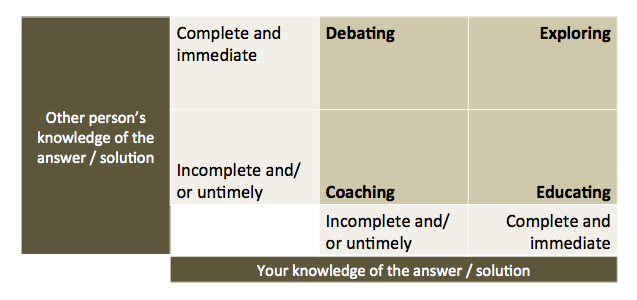
Now that’s established, I want to make a distinction between democracy (participating in the selection of the decision) and the discussions leading to decisions – which I will call the debates.

The debate is not a democratic process. Let me use an example to explain why I have an issue with opening debates to crowds.

Following another disappointing loss of our local hockey team, a few colleagues gathered in the cafeteria were loudly debating their opinion on the cause of the team’s poor performance…

  • Paul: “Price [the goal tender] doesn’t deserve to play with the team, he lacks consistency…”
  • Mario: “What do you mean? Price did what he could but he can’t do everything. With Markov’s and Gill’s injury our defensive line is weak and Price is too often left to himself…”
  • Richard: “Did you guys watch the same game I did? We have no offensive line. We gave a lot of talent to bring Cammalleri to Montreal but he is just not the scorer we need and nobody actually has the right skills…”
  • Mary: “No, no. It’s the referee who influenced the game…”

I’ll stop here but that is enough to show my point. How many of these people do you believed played in the NHL? None.

How many of these people took coaching training or even played junior hockey? None.

How many of these opinions are actually useful to make the right decision? None. That’s right!

This is what my wife calls the “comments from the peanut gallery“.

Let me use another brief example to prove my point further.

Assume a skilled people manager joins his highly technical team for a brain storming session. The team is looking to improve performance of their Java application and the tension in the room is high.  The manager – for sake of clarity, doesn’t have a clue about computer programming except maybe for a 3 hours introduction to Microsoft Excel taken 5 years ago – suggests to replace the framework and maybe the sorting method. What are the chances that his suggestion will be accepted? None.

The same situation applies when people with no management experience or training jump into a discussion about people management or organizational strategies. To take part of the discussion there needs to be a few pre-requisites. It is not enough to want to participate in the discussion, to really contribute people need: knowledge of the topic being discussed, experience, and a willingness to move the debate forward.

What is not needed is a personal opinion without facts, knowledge or experience but this is exactly what happens when a debate is open to the general public. When these conditions are met (knowledge, experience, and willingness), people should be welcomed to join the discussion so to take advantage of the wisdom of crowds. When these conditions aren’t met, people should stay on the sideline waiting for the debate to end and propositions to be open for selection.

Just like in the Canadian Parliament, a selected (elected) number of people were selected to represent others in the discussion. Once options are selected, the democratic process can allow people to vote.

  • Share/Bookmark

Using silence as a communication tool

November 23rd, 2009 Martin Proulx No comments


Using silence as a communication tool

Using silence as a communication tool

Have you ever heard the expression “You have two ears and only one mouth so you should listen twice as much as you speak”? What about “Silence is gold”? It doesn’t matter if you have never heard these expressions, you will still be able to take advantage of this under-utilized ability.

Chances are, you have participated in meetings or conversations where people talked, and talked, and talked for no apparent reason only to show-off in front of colleagues or their boss. When you sit back and listen, you often notice that despite the noise, the conversation isn’t moving forward. In these instances, people are concerned with demonstrating something (their knowledge, their communication ability, their decision-making power, etc.) rather than really communicating. Most of the time people talk too much. Way too much.

Over the years I have found that using silence is very useful. Contrary to what a former boss told me, being reserved in a meeting and participating when necessary is much better than talking all the time in order to get noticed. If the only way for you  to get noticed in your organization is by talking a lot during meetings, you are in trouble. I would think that conversations are probably as shallow as the level of competence of the management team – but I digress.

Many people assume that communicating is simply talking nonstop. They are not aware of how they are being received and perceived by others. Using silence on the other hand is very useful. As a communication tool, silence provides a few interesting benefits:

  • it allows you to actually listen to other people’s perspective;
  • it lets your colleagues complete their thoughts without rushing;
  • it provides space for people to express their opinions or feelings;
  • it makes people feel their perspective is valued;
  • it allows you to organize your thoughts and emphasize one point or another;
  • it builds anticipation in your audience and allows them to follow your message;
  • it leaves room in the conversation to allow people to share something they might want to tell you but weren’t quite ready to do so;
  • during negotiation, it adds a little pressure on the other person to possibly offer a better deal;
  • and as a bonus, it improves people perception of you – you no longer appear self-centered and in need of visibility.

When your ego and your need for power drive your conversation, you are certainly missing out on critical pieces of information. Humility and serenity will increase your communication ability. If you are able to develop the ability to remain silent for a certain amount of time in a conversation, you will quickly discover the benefits.

  • Share/Bookmark

It's a bad idea to hire super heros

November 4th, 2009 Martin Proulx No comments


Don't hire super heros

Sure, super heros are powerful. They have strengths and abilities that regular humans don’t possess. They can always be counted on to save the day and they wear cool suits! But…

Have you considered the damage a super hero can do to your team, to your department, and sometime to your organization?

Over the years, I have had the opportunity (?) to work with super heros. Every time, the initial reaction is always the same – wow, this individual is amazing! Eventually, after I analyze the accomplishments, look at the situation and the impact on others around the super hero I am less than impressed. Here’s why:

  • Having a super hero hides the real underlying problems because the super hero will always save the day – no matter what caused the situation to start with. Unless you have a retrospective or a post-mortem following the resolution of the problem, you will not be able to assess if the problem is likely to happen again in the future;
  • A super hero causes resentment within a team since he is typically the one rewarded for the efforts. In addition, a super hero loves the spotlight and will seldom share it with other people who helped resolve the crisis;
  • A super hero thrives on solving problems and some have been known to spark an explosive situation so they can jump in later on to resolve it.

Everything is not lost if you have a super hero on your team. Next time he saves the day, simply thank him for his action and then reward the individual who suggests and implements a way to prevent the situation moving forward.


  • Share/Bookmark

Happy 1st anniversary Analytical-Mind

October 27th, 2009 Martin Proulx 3 comments
1 year of blogging

1 year of blogging

It has already been 1 year since I published my first blog post. As I quickly figured out, Blogging is like training! It requires time, energy, and commitment and when it is done regularly, it is a great exercise for the mind.

In the 154 posts published since the beginning, my blog has evolved – a lot. I admit, I originally had no real focus and mostly expressed personal opinions.

I realize my style is a mix of situational analysis (analytical-mind), philosophical perspective, suggestions and advices sometime using humour to convey my message.

Finally, my most popular posts were:

  1. How I failed as a Product Owner and the lessons I learnt in the process
  2. The Prisoner’s Dilemma: Applying Game Theory to Agile Contracting
  3. My Virtual Bookshelf
  4. Less projects were reported to be successful in 2008
  5. Scrum Artifact: Burn Down Chart

In order to improve my blog moving forward, I did a 1-year retrospective and I asked myself 3 simple questions.

What do I feel I did well?

Although there were times when I didn’t publish for a few weeks, I remained committed to maintaining the blog. Not all posts have the same depth but I try to share my perspective and discuss a different way of doing things with the objective of improving people’s quality of life at the office and improving the return on organizational investments.

What do I feel I didn’t do well?

Until I decided which track to follow, I wasn’t focused. It was difficult to retain readers since they didn’t know what to expect.

What do I need to start doing?

Increase collaboration with other bloggers and stay focused on the topics of innovative management, new organizational structures, and leadership.

  • Share/Bookmark

Why didn't my plant tell me it was drowning?

October 13th, 2009 Martin Proulx 2 comments

The problem with slow feedback loop

The problem with slow feedback loop

I recently re-read The Fifth Discipline: The Art & Practice of The Learning Organization. Peter Senge talks about the impact of feedback loops in individuals and organizations’ learning process. Feedback loops (aka retrospection) are also critical in Scrum and the Agile approach.

What does this have to do with my plant you ask? Simple. I was the victim of a slow feedback loop myself and it almost killed my wife’s beautiful Azalea.

A few weeks ago, I bought my wife a beautiful Azalea for our anniversary. It was in full bloom. It was simply beautiful!

In addition to looking very nice, the salesperson at the flower shop told me it was low maintenance. This is a key feature for us since we usually don’t do very well with house plants. I bought the plant and took it home.

Following the instructions, we would add water every few days and made sure the plant didn’t have too much direct sun light. One morning, we noticed some of the beautiful flowers were starting to dry out. Experience tells us that when something is dry, you add water – so we did. We increased the frequency of the watering ritual from once every 4-5 days to once every 2-3 days.

Much to our surprise, the situation didn’t improve. Actually, it was even worst, more flowers were drying out – so we thought, let’s add more water. We moved the plant next to the kitchen sink so we would remember to add water every morning when preparing coffee. A week passed by and the results got worst. In addition to dry flowers, the plant was loosing all its leaves. It started to look pretty bad.

While I was preparing coffee this morning, I went to add water to the plant only to discover that the plant was immersed in water. There was so much water that it covered the earth in the pot! S*%t! We are drowning the plant!!

Then it hit me. Because we weren’t getting any obvious feedback, we assumed what we were doing was good and we continued until it was almost too late. Had we had indications sooner that our actions weren’t the right ones, we could have changed them and possibly address the right issue.

This is exactly what we teach our customers and what Peter Senge was explaining. Without rapid feedback loop, it may take a while for people to realize they have been doing something wrong.

  • Share/Bookmark

The new employee has an opinion

December 30th, 2008 Martin Proulx No comments

You are the head (vice-president, director or manager) of your business unit and you recently hired a new employee*. This new recruit is filling in a key role and he/she is expected to deliver on his/her objectives.

You have translated the corporate vision and mission into SMART objectives (Specific, Measurable, Achievable, Realistic, Timely) and you think of yourself as an innovative leader and believe your team members need to be empowered. Obviously, this senior employee is not simply filling an execution role where he/she needs to do what he/she is told.

After a few weeks, the new employee comes to you with a different way of managing the team. His/her suggestion would most probably (in his/her mind at least) increase productivity and improve employee moral. Which of the following answers better reflect your reaction?

  1. Listen to the idea, politely smile and let the employee know he/she needs to wait 6 months before he/she is entitled to an opinion.
  2. Kindly listen to the proposal and let the employee know that he/she has it all wrong. Things don’t really work the way he/she perceives it.
  3. Thank the employee for volunteering the information and ask him/her to prepare a lengthy SWOT analysis (strength, weakness, opportunity, threat) in the hopes he/she abandons the idea.
  4. Ask the employee to join you for lunch in order to better understand his/her perspective.

These weren’t trick answers. I have personally seen these 4 answers being given to new employees in various contexts. The point here is not to criticize the answers or the approach used but to highlight a key issue behind the answers.

Answer #4 is obviously the only one opening up a dialogue where the employee and the manager talk about perceptions, culture and work environment. Assuming the feedback was brought forward in constructive manner, even if the employee’s observations were not accurate, it has the amazing benefits of making the employee feel good – someone wants to hear his/her perception – in addition to establishing a relationship between the employee and his/her manager.

Answers #1, #2, and #3 immediately show that the person in charge either feels they can’t learn anything useful from a new employee or don’t care to know what the new employee has to say. Once again, assuming the employee brought the feedback in a constructive fashion and even if the supervisor doesn’t have anything to learn, wouldn’t there be benefit in maintaining an open channel of communication between the manager and his/her team? Unfortunately, it seems many people do not think so.

* This exercise also works for external consultants.

  • Share/Bookmark