Archive

Posts Tagged ‘agile management’

Agile Leadership (Agile Management) – part II

January 26th, 2010 Martin Proulx No comments

Picture provided by kansasphotoLike most modern Homo sapiens, when you hear Agile Leadership or Agile Management, you think of:

  • [if you are outside the business world] A business-person who can use a combination of balance, coordination, speed, reflexes, strength, endurance and stamina to achieve his objectives;
  • [if you are inside the business world but outside the information technology field] A person who has the capability of rapidly and cost efficiently adapting to changes in an attempt to deliver on his objectives;
  • [if you are inside the information technology field] A person who manages a software development team who uses methodologies based on iterative development, where requirements and solutions evolve through collaboration between self-organizing cross-functional teams with the objective of delivering value.

I apologize if you are outside the business world because this is not the perspective I wish to cover. For people in the other two categories, you are partially right.

I attempted to define Agile management and see how I could apply Agile principles to management a while ago and since then, I have been able to piece the puzzle together. Agile Leadership requires less technical knowledge than its cousin but it heavily relies on the same principles.

A high level view of the model

Agile Leadership Model (Summary)

If you have been reading my blog for a while (thank you!) and even if you haven’t, you will realize that I have been covering various parts of this model already:

People: The people dimension covers all aspects of competencies, motivation, culture, collaboration and communications that enable the organization to achieve its business objectives. While every effort is directly or indirectly related to people, this perspective focuses primarily on the ability of individuals to contribute to the achievement of objectives.
[related tags: 360-degree feedbackcoachingcollaborationcommunitydecision makingfeedbackleadershipmanagementorganizational structurepeople management,servant leadership]

Processes: The process dimension aims to define the working methods and approaches to be followed in carrying out tasks in line with the overall objective of delivering business value.
[related tags: agileagile managementscrum]

Tools: The technology dimension covers the various tools and technologies that support the organization in achieving its business objectives.
[related tags: none, I haven't covered this dimension]

Value: The value dimension covers the business capacity to effectively deliver value within the appropriate time. The delivery of value is the fundamental purpose of the organization.
[related tags: ROI]

As you can see, I have mostly covered the People dimension of the model while I have purposely left the Tools section un-covered. The reason for this is that there are already thousands of web sites on the topic of Agile and technology.

In an upcoming series of blog posts, I will present a more detailed perspective of what Agile Leadership truly means based on our experience. Stay tuned…

  • Share/Bookmark

Interesting blog posts (January 22, 2010)

January 22nd, 2010 Martin Proulx No comments

On the importance of creating the right organizational culture (Thanks to Andrew)

By the time we got to 100 people, even though we hired people with the right skill sets and experiences, I just dreaded getting out of bed in the morning and was hitting that snooze button over and over again Corner Office – Tony Hsieh of Zappos – Celebrate Individuality – Question – NYTimes.com.

On why an Agile approach is better suited to deliver value (Thanks to Alfonso)

Most organizations that depend on software are struggling to transform their lifecycle model from a “development” focus to a “delivery” focus. This subtle distinction in wording represents a dramatic change in the principles that are driving the management philosophy and the governance models – Improving Software Economics

On the meaning of Agile transformation for managers

What many people mistakenly do is equate agile project management with doing more work, with less documentation and fewer people. Although the premise is to get more done in a more favorable way, I have never met a team that could successfully implement agile principles without having to slow down first - VersionOne – Agile Adoption For Managers.

On the fact that the true value of an organization is not mapped via its organizational chart

But it’s not the fact that you have many more boxes and lines that I’m most envious of.  It’s your “white space” I want – Oh, Yeah? Well, My Org Chart is Bigger and More Beautiful Than Yours!

On the need to manage self-organized teams when required

The interesting thing is, the further we go into agile management territory the less typical the managerial job we expect. Teams are self-organizing and cross-functional, and sometimes we think a manager should just get out of the way. By the way, surprisingly often this is exactly the best choice. But whenever one of the asshole-moments is needed, it is time to show up and do what has to be done. Otherwise the atmosphere starts rotting as people wait for someone who will fix things. Someone who will do something about this guy adding a new technology every time he reads some nice article. Someone who will deal with that lass taking a few days off because she doesn’t really care about the project being late and the team working their butts off to get back on the right track. That’s always a job for a manager, and a harsh one, no matter how self-organized the team is - Good Managers Sometimes Have to Play Assholes – NOOP.NL.

  • Share/Bookmark

The Strategic Café or “A bottom-up approach to setting a corporate strategy” (Day 2)

December 17th, 2009 Martin Proulx 1 comment

As a follow-up to my earlier blog post on this topic, below is the agenda of our meeting as well as the questions asked during the sessions. If you are not already doing so, I strongly recommend you start using this facilitation approach to improve your meetings – including your next Strategy Definition meeting.

Strategic Café

If you would like more information on how to organize your own Strategic Café, you can drop me an email (martin [at] analytical-mind.com). I’d be happy to help.

Strategic Café

Agenda – Day 2

Breakfast (8:00 to 8:25)

Welcome and meeting introduction (8:25 to 8:30)

Presentation of our initiatives for the next 6 months (8:30 to 11:00)

Strategic Café

Pause (11:00 to 11:30)

Strategic Café

Prioritization of our initiatives for the next 6 months (11:30 to 12:15)

Lunch (12:15 to 1:00)

Strategic Café

World Café – Strategic assessment of our environment (1:00 to 2:30)

Background: To correctly set up our strategies, we must understand the environment in which we operate for: our consulting service, our products, and our training.

Question: What are our strengths, weaknesses, opportunities and threats in each sector of activity?

Tables:

  • Products
  • Products
  • Consulting Service
  • Consulting Service
  • Training

Mechanics: The participants are allowed 12 minutes at each table.

Strategic Café

Pause (2:30 to 3:00)

World Café – Operational improvements (3:00 to 4:30)

Background: In order to continue our growth, we must give ourselves the means to grow up, what are the improvements that wants to carry out: sales, marketing, finance, human resources and SME.
Question: How does improve on our operations to do the goals we had set?
Tables:
  • Sales
  • Marketing
  • Finance
  • Human Resources
  • Subject Matter Experts
Mechanics: The participants are allowed 20 minutes at each table.

Strategic Café

  • Share/Bookmark

The Strategic Café or "A bottom-up approach to setting a corporate strategy" (Day 1)

December 9th, 2009 Martin Proulx 1 comment

If you ever had a chance to participate in a Strategy Definition meeting, you either had a good time because YOU were dictating the strategy to follow or had an awful experience because your recommendations were totally altered, down-graded to a point of irrelevance or blown out of proportion making them un-achievable. Needless to say, for most people a Strategy Definition meeting is an experience comparable to a visit to the dentist for a root canal.

As I already mentioned, not only is our organizational structure different from most organizations but so is our strategic process. As opposed to a top-down Strategy Definition where the Top Executives come up with the Strategy, we use a bottom-up approach. Once again, we rely on the wisdom of the crowd to come up with the best strategy we can achieve. Not only is the strategy sound, it also removes the need to obtain buy-in after the fact since employees participated in the definition of their strategy.

We’ve implemented a Balanced Score Cards approach to our strategic planning process 6 months ago. This approach is helping us move forward but the format of our previous meetings left a lot of room for improvement. After asking around for an alternate approach for the meeting, François suggested we try a World Café format. After reading about the principles and the book (The World Cafe: Shaping Our Futures Through Conversations That Matter), we spent time preparing and planning for the meeting. Needless to say, the Strategic Café was a huge success.

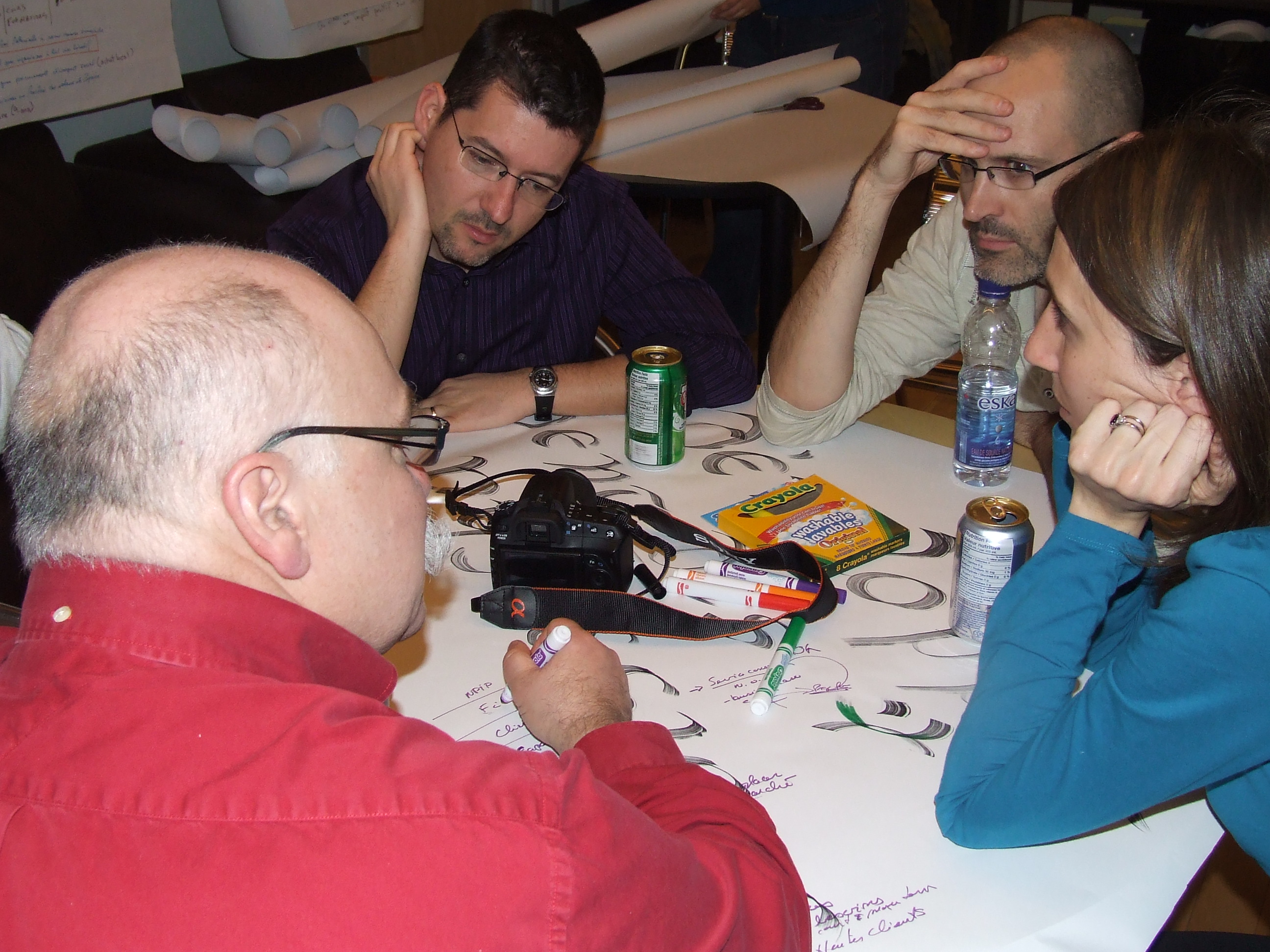
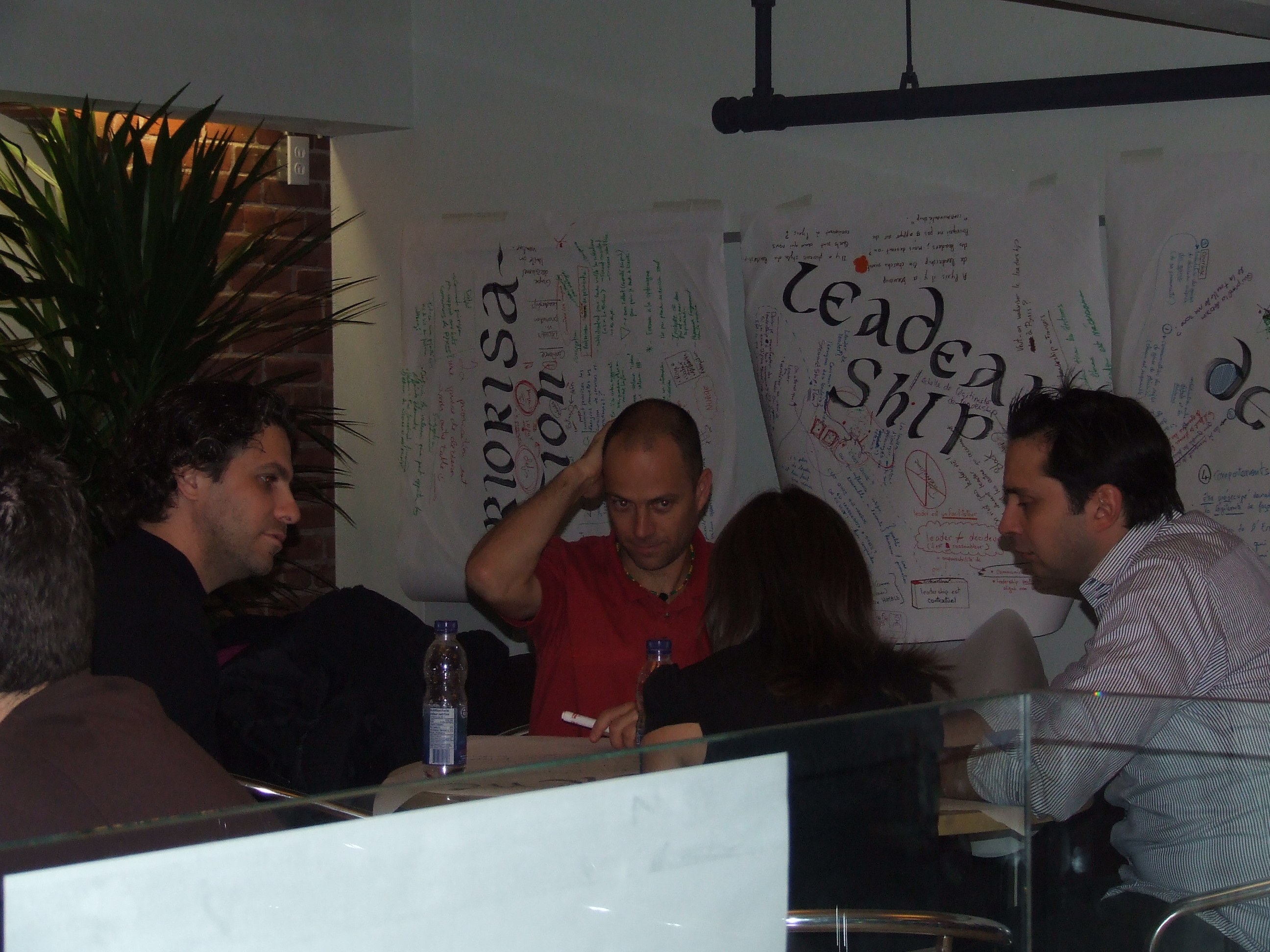
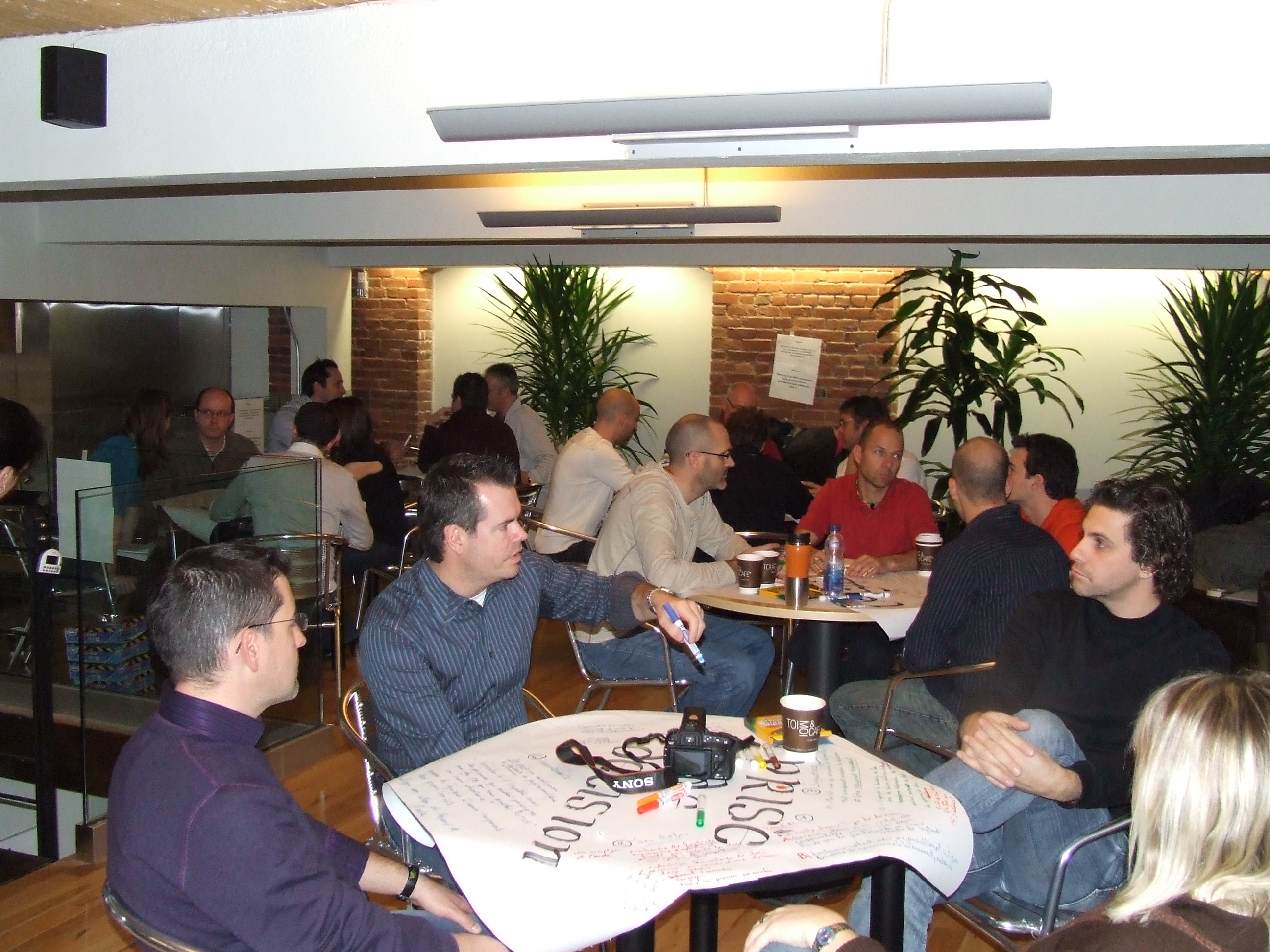
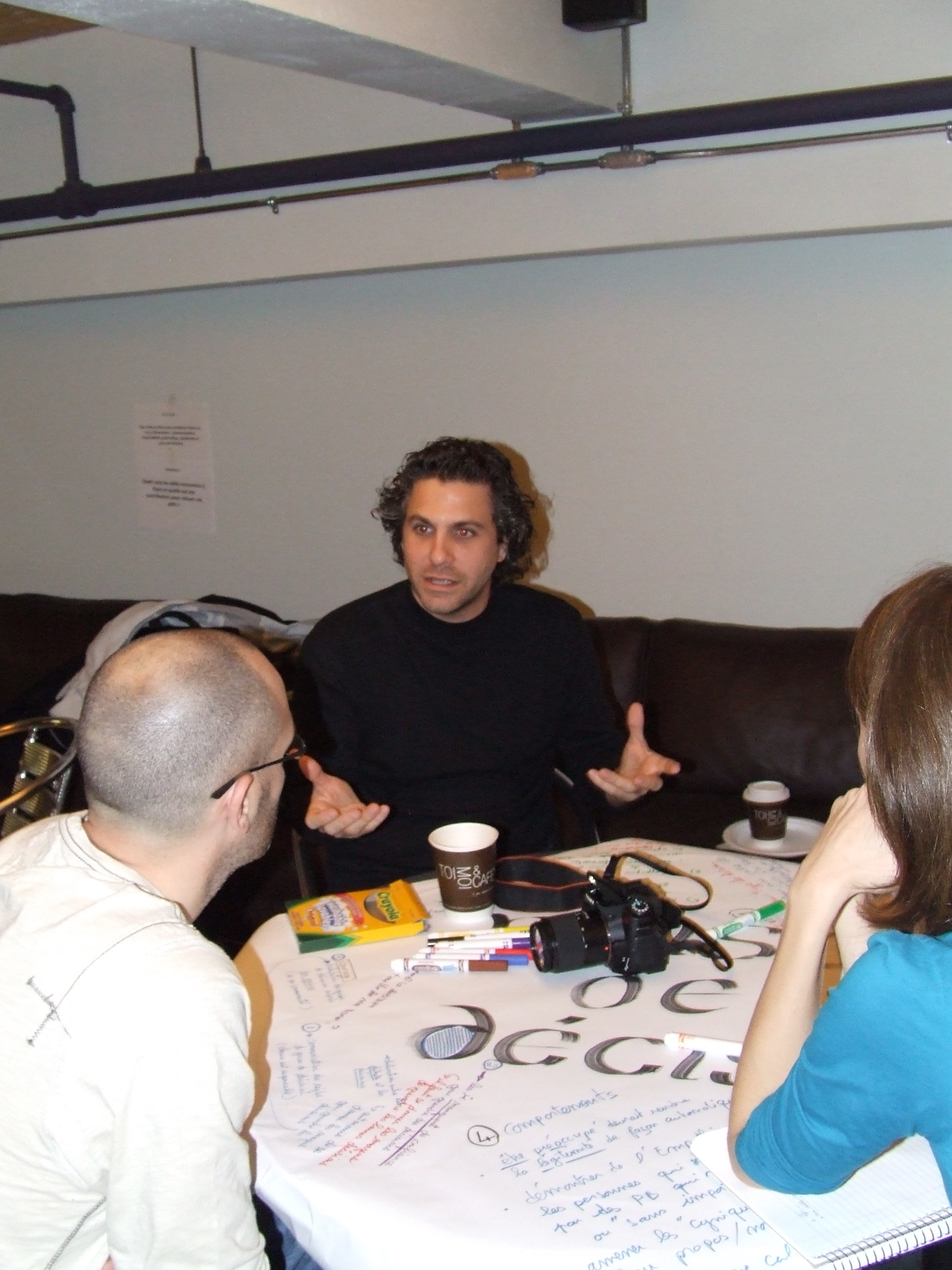
World Café used to Define the Corporate Strategy

I want to sharing with you the agenda of the meeting as well as the questions asked during the sessions. If you are not already doing so, I strongly recommend you start using this facilitation approach to improve your meetings – including your next Strategy Definition meeting.

If you would like more information on how to organize your own Strategic Café, you can drop me an email (martin [at] analytical-mind.com). I’d be happy to help.


Agenda – Day 1

Breakfast (8:00 to 8:25)

Welcome and meeting introduction (8:25 to 8:30)

Warming up the brain cells (8:30 to 8:45)

We asked participants to compete in a friendly game of Rush Hour. The intend was to introduce a fun element in the day in preparation for the meeting.

Strategic Café

World Café – Retrospection of the previous 6 months (8:45 to 10:30)

Background: What should be done to improve the organization on the following 5 dimensions: communication, accountability, prioritization, leadership and decision making?

Question: What are the challenges encountered within the organization and what is my contribution to meeting these challenges?

5 Tables: Communication, Accountability, Prioritization, Leadership, and Decision Making.

Mechanics: The participants are allowed 15 minutes at each table.

At the end of the exercise: Each of the 5 paper-table-cloths is assigned to an individual responsible to come up with a plan of actions.

Strategic Café

Pause (10:30 to 11:00)

Presentation of the new governance model (11:00 to 12:30)

Unfortunately, this part is confidential ;)

Lunch (12:30 to 1:15)

Strategic Café

World Café – Improvement to the well-being of people (1:15 to 3:00)

Background: In 1 year from now, what will be the impact of our organization on the following 4 sectors: employees, existing customers, stakeholders, and potential customers?

Question: What programs should we develop to meet our objective of improving people’s well-being?

4 Tables: Employees, Existing Customers, Potential Customers, and Society.

Mechanics: The participants are allowed 20 minutes at each table.

At the end of the exercise: Participants were asked to select the top 4 priorities for each of the sectors and write them on a master flip-chart. Participants were then asked to vote to select the top 4 priorities overall on which the organization would invest time, energy and resources to move forward.

Strategic Café

Pause (3:00 to 3:30)

Strategic Café

World Café – Selection criteria to prioritize our initiatives for the next 6 months (3:30 to 5:15)

Background: Given the limited resources and the large number of initiatives within our organization, which criteria do we want to use to prioritize and select the initiative that we will move forward using the following areas: Financial, Customer experience, and Employee learning and growth?

Question: Which criteria we will use to determine our priorities?

3 Tables: Financial, Customer Experience, and Employee Learning and Growth

Mechanics: The participants were allowed 20 minutes at each table.

At the end of the exercise: Participants were asked to select the top 4 priorities for each of the sectors and write them on a master flip-chart. Participants were then asked to vote to select the top 4 priorities overall. Those would become the criteria used to prioritize our initiatives for the next 6 months.

Strategic Café

Dinner (6:00 to 8:30)

As an analogy to our Strategic Meeting, we had organized dinner at O’Noir.


I’ll be publishing Day 2 of our meeting shortly.

  • Share/Bookmark

Don't Sell Buzzwords to Business Leaders, Learn How to Describe Real Value

August 28th, 2009 Martin Proulx 1 comment

During a break from the exhibit hall, I had the opportunity to  attend the presentation given by Rich Sheridan, CEO of Menlo Innovations called “Don’t Sell Buzzwords to Business Leaders, Learn How to Describe Real Value“.

Although I was disappointed at first because the presentation actually didn’t have anything to do with “Buzzwords” and “Business Leaders”, I quickly changed my impression once Richard started to describe his company’s culture and the way he leads his organization. As I already mentioned, our organization operates very differently from most organizations and in an attempt to adapt the right organizational structure I’m reading as many books, articles and blogs on this topic – including Maverick: The Success Story Behind the World’s Most Unusual Workplace (thanks to Andrew Meyer for the reference).

You can understand my interest once Richard talked about making similar organizational choices as we did: complete transparency, no formal hierarchy, accountability towards your team instead of a boss, well developed recruitment process, equitable compensation, open work environment, etc.

Menlo Innovations has published a book that demonstrates how their way of operating does deliver the real value as expected by their customers. I have ordered the book since it wasn’t available on site and I will certainly provide my assessment of it once I receive it.

Needless to say, the presentation captured the interest of most of the people in the room and many were hoping to have lunch with Richard after the presentation to better understand his unusual work environment. Unfortunately for me, my break was over and I had to get back to the booth.

I will obviously continue my research on this topic.

  • Share/Bookmark

Defining Agile Management – part 1

August 10th, 2009 Martin Proulx No comments

Following a post I wrote a few months ago, I keep trying to define the principles behind agile management and so far I came up with the following:

  • Be humble: When it comes to the details, your team knows more than you do. Tell your team what you are trying to achieve and the reasons why but don’t tell them how to achieve the goal. Offer your help if they need it.
  • Provide space for experimentation: Not all outcomes are known at the beginning of a project. Give your team time and resources to experiment. Playing is highly educational.
  • Try quickly: When someone has an idea, try it out immediately with a trusted audience. No single brain can anticipate all potential issues. Share the ideas as soon as possible to get feedback.
  • Start small: In line with the previous principle, use prototypes. An incomplete tool will provide far more information than a simple explanation. People need to see and feel things, don’t just rely on their imagination.
  • Learn from mistakes: Allow failures and learn from them. Nothing significant has been accomplished in a single iteration.
  • Do not punish failures: In line with the previous principle, failure is part of the learning process. Penalizing people for their mistakes sends a strong message that your team is risk averse.
  • Maintain constant communication between the demander and supplier: Communication is key to building relationships. Bi-directional communications will help prevent assumptions and increase chances of success.
  • Have strong integrity: Say what you will do and do what you have said. People will respect you for it.
  • Do not be afraid to commit: Nobody likes indecisive people. Commit to other people will give you increased credibility.
  • Make sure to re-negotiate: In line with the previous principle, if you are unable to meet your commitment re-negotiate them immediately. Do not wait.
  • Focus on results and not process: The methods used to achieve results are much less important than the results themselves.

What are your thoughts? Have I missed anything important?

  • Share/Bookmark

Inline with an Agile Organizational Structure

August 6th, 2009 Martin Proulx 2 comments

As time goes by, I realize there is no such things in life as coincidence. I’ll probably expend on this topic in an upcoming post but for now I’ll jump to the purpose of today’s blog post.

If you have been reading some of my recent posts (this one, this one and this one) you will notice that I took upon myself to help implement an innovative organizational structure for the organization. As a consequence, Raphaël suggested I take a look at Holacracy.org.

I had the pleasure of sitting in on the webinar given by Brian J. Robertson from Holacracy and found the content was very much in line with the organizational structure we are aiming to implement. In short, here are two take-away I got from the presentation:

  • We need to distinguish the organization from the individuals that compose the organization.
  • The organization has to be purpose driven. Its goal is not only to generate profits for the shareholders but to have a purpose of its own.

Although there is much more to this than these 2 points, the 60 minutes presentation gives a good introduction to the concept. I am unfortunately unable to attend their next events in Philadelphia and Dallas both hopefully they will add events to their calendar shortly.

If you get a chance, I suggest you sign up for one of their upcoming presentation and share your thoughts.

  • Share/Bookmark